Laser marking and industrial treatments: staying in control of mark durability after processing!
Marking the part is not the problem; remaining legible after treatment is
E-coating, paint, shot blasting, sandblasting, heat treatment, machining, phosphating: every downstream treatment takes its own toll on the mark. A coating buries it, shot blasting pounds it, machining cuts it away, heat treatment eliminates its contrast.
And yet traceability depends on the code still being usable once those operations are complete, sometimes as far as the end customer.
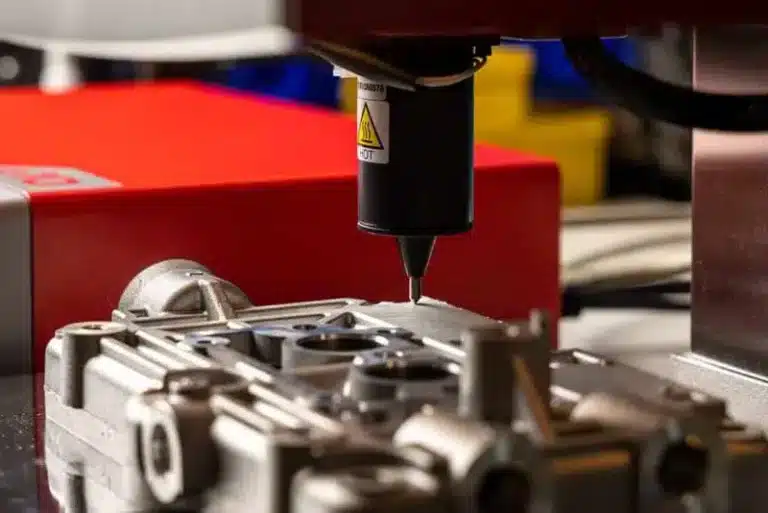
Laser marking addresses this constraint. With no contact and no consumables, it works across a wide variety of materials and production throughputs. More importantly, the parameters selected allow it to create marks whose physical characteristics differ considerably, which makes it compatible with most industrial treatments.

Laser marks are far from interchangeable: A single laser will produce marks whose physical properties vary widely with the parameters selected: depth, relief, how the beam interacts with the material. Subjected to a given downstream treatment, certain marks survive while others are wiped out.
The laser is only part of the equation: A single laser gives widely differing results depending on which marking method is applied. Equipment and method together determine whether the mark will come through the treatment the part is scheduled to receive.
Fade away or hold up: two conflicting needs, and sometimes they coexist on a single part:
Internal traceability: the laser marking does its job during production and is then expected to disappear beneath the final treatment.
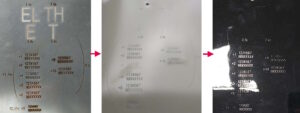
Case in point: letters that identify a powertrain variant on a vehicle door, serving as an error-proofing (poka-yoke) marker at assembly before being hidden under the paint.
End-to-end traceability: the laser marking needs to stay legible once treatment is complete. Serial number, Data Matrix code mandated by a standard or meant for the end customer.
The same laser takes care of both scenarios on one and the same part. On vehicle doors, the EL/TH letters were gone after e-coating and black paint, yet the serial number was still legible. One laser does the work; nothing changes except the marking parameters.
The results presented here come from actual production applications. Real parts, marked and then sent through our customers’ own manufacturing processes. Every treatment raises a distinct problem for the mark. And every one of them has a solution.
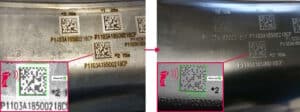
Whether on steel or on aluminum, a Data Matrix code marked ahead of e-coating is still legible once the coating has been deposited.
In this instance, an automotive chassis part (Body in White): a Data Matrix code plus its associated text, marked prior to immersion in the KTL bath.
Once treated, the code is still perfectly legible. Marking took 12s in this case.
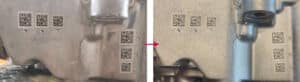
Shot blasting alters the shape of the code cells on the surface. So that the Data Matrix code can still be read after impact, the marking parameters are tuned to the size of the blasting media in use.
For this application, nine marks distributed across several locations on an aluminum gearbox housing made it possible to confirm the repeatability of the process. A Data Matrix code takes between 6 and 10 seconds to mark, depending on its size, at a depth of about 0.2 mm.
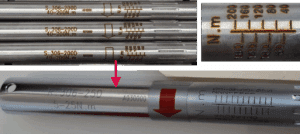
If the treatment takes material away, the mark needs to go deeper than the layer being removed.
In this example, a mark is applied to torque wrench parts. The tube then goes through a grinding operation that affects the marked surface. A marking depth of 0.2 mm is reached, with a cycle time of 38 seconds that includes rotating the tube.
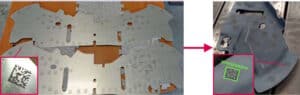
Heat treatment is capable of sharply fading any visual contrast the mark may have. The operation is usually applied to steels and cast irons.
In this case, a sheet metal automotive part is put through this treatment and is brought up to 950 °C after marking. Using properly matched parameters, the contrast holds and a standard, off-the-shelf code reader decodes the Data Matrix code with no trouble. The marking time comes to 2 seconds for a 12×12 mm code.
Material, geometry and downstream treatment combine to produce a result that is specific to each case. There is no reference chart that can predict it. Validation takes place on your own parts, inside your own process.
The method: specification of the need (content, code size, cycle time, downstream treatment), marking of representative samples, a pass through your real production flow, and a legibility check after treatment. The reading conditions (lens, lighting, angle) are included in the optimization work.
The outcome: a feasibility report containing documented results and validated samples, delivered before you commit to any equipment.