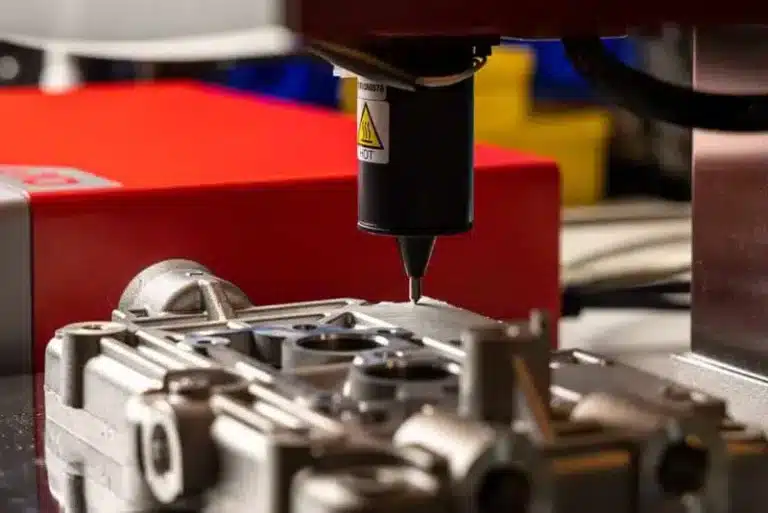
In industrial manufacturing, it is essential to understand the distinction between industrial engraving and deep marking.
While engraving depth can vary and adapts to a range of aesthetic or informational applications, deep marking of industrial parts is engineered primarily for durability and wear resistance.
Deep engraving stands out for its ability to produce markings whose durability far exceeds that of conventional engraving. By frequently exceeding a depth of 0.2 mm, direct part marking effectively withstands mechanical wear, heat-treatment processes, and even harsh chemical exposure.
Deep marking addresses critical requirements such as permanent traceability, resistance to extreme environments, compliance with industry standards, security and tamper resistance, maintenance tracking, and part lifecycle management.
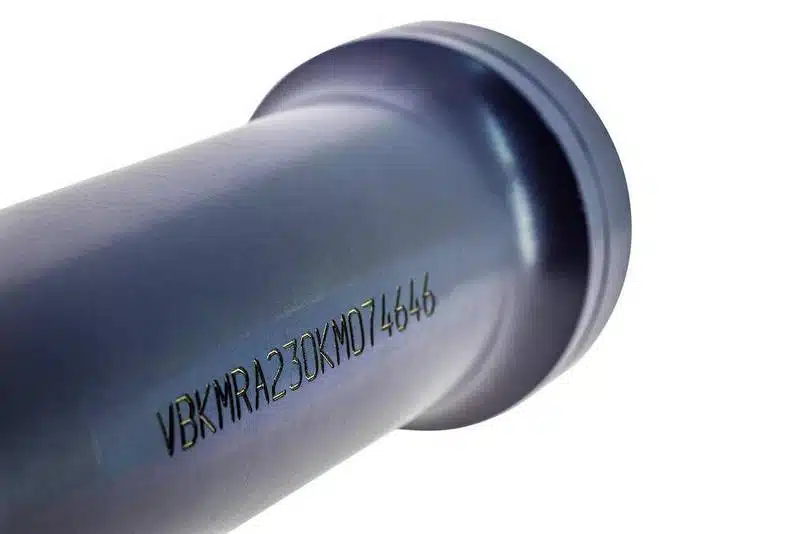
Thanks to its integration into the material itself, deep direct marking ensures optimal readability and protection against falsification or tampering, which is essential in high-requirement sectors such as aerospace, rail, or defense.
The marking technologies used for deep engraving often combine several methods to achieve the required depth and precision.
Depending on technical and economic criteria, SIC MARKING offers a range of deep engraving machines addressing the requirements of direct marking for industrial parts.
To select the marking technology best suited to a given deep engraving application, manufacturers must rigorously account for several technical, environmental, and economic criteria.
It is necessary to assess the nature of the material to be marked, its hardness, and its heat treatment, since certain technologies such as laser or electro dot peen marking may be limited on very hard or heat-treated materials.
By evaluating these factors, manufacturers ensure not only the effectiveness and durability of the marking, but also cost optimization and compatibility with the industrial process.
Material Properties
The Importance of Marking Depth
Size and shape of the part to be marked
Environmental Considerations
Type of information to be tagged in depth
Total Cost of Ownership for Evaluating the Investment
All of these factors must be considered in relation to the volume of marked parts and the required depth.
Deep scribing is a mechanical technique that produces linear marking that is durable and precise across a range of materials. It is particularly valued in demanding sectors such as defense, construction, and rail, where resistance to environmental stress and readability are essential.
This method delivers silent marking, free of high-impact force, which preserves part integrity while ensuring reliable traceability and protection against falsification.
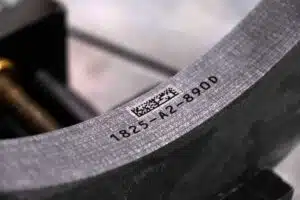
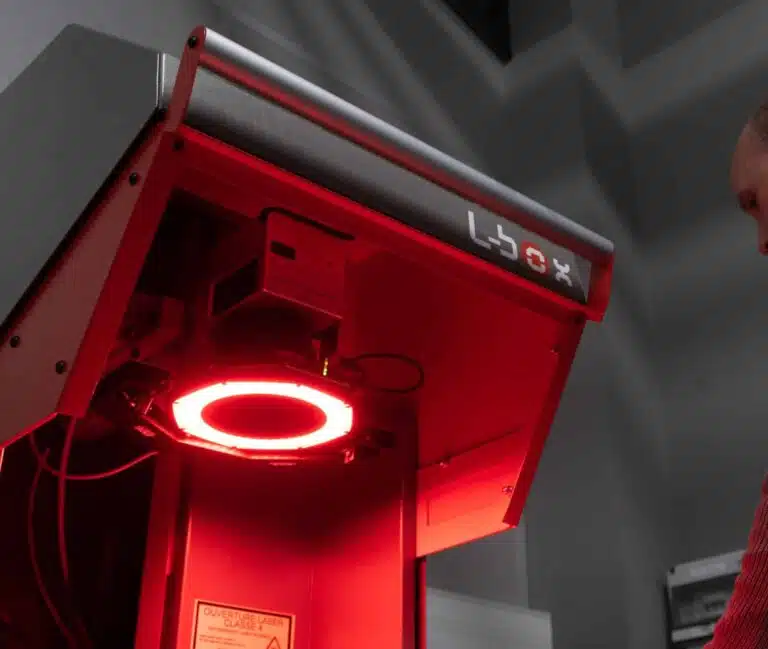
Deep fiber laser marking is an advanced technology that uses a high-density laser beam to engrave with precision and durability across a range of materials.
Laser marking is the technology of choice in demanding sectors such as defense, aerospace, or rail, where visual quality and marking durability are paramount.
Thanks to its multi-pass capability, it ensures optimal engraving depth without altering part structure. Manufacturers value its ability to produce secure, readable codes, essential for traceability and compliance with strict industry standards.
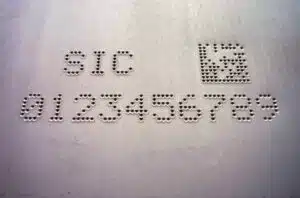
Deep electromagnetic dot peen marking offers a precise, durable solution for industrial part identification.
It uses a stylus driven by a magnetic field to stamp clean, uniform indentations into a variety of materials, ensuring reliable traceability without damaging the surface.
Contact Us
Need more information?