Pattern hero

Steel Component Marking

One of the most widely used materials in industrial manufacturing, steel is defined by a distinctive balance of hardness, ductility, thermal conductivity and corrosion resistance — properties that shift according to its alloy composition.
An iron-carbon alloy enhanced through alloying additions, it provides a high degree of adaptability via heat treatment processes (quenching, tempering, annealing) and the integration of alloying elements to tailor performance to specific manufacturing requirements.
Depending on steel hardness, surface condition, production environment or the required marking type (Datamatrix, serial number, deep marking…), SIC MARKING offers several families of steel marking machines:
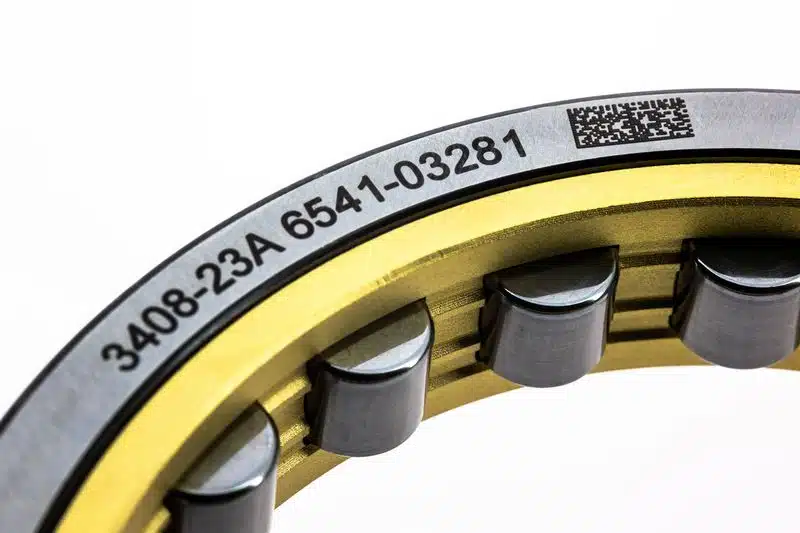
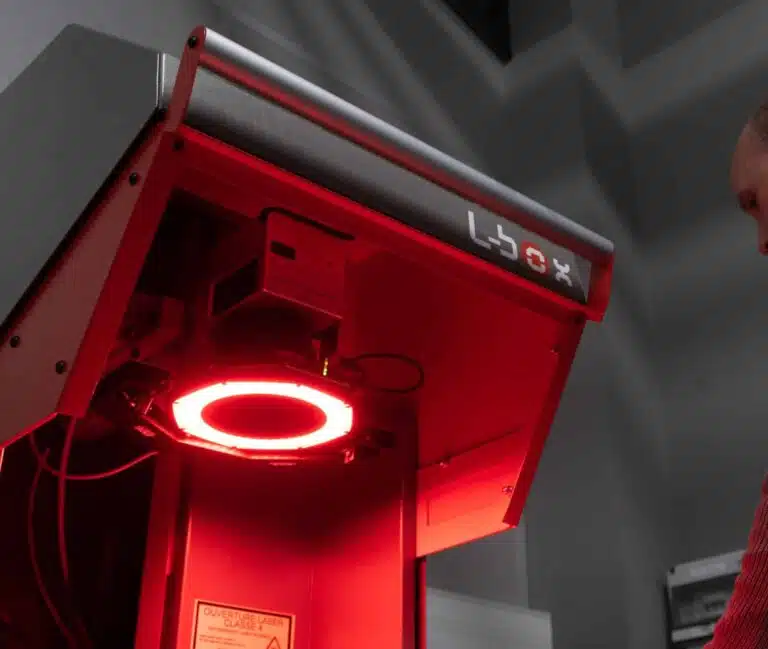
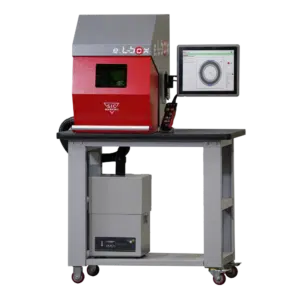
  • Laser marking machine for steel: standalone laser stations, integrated laser heads for automated production lines, or compact laser units for semi-automatic workstations,
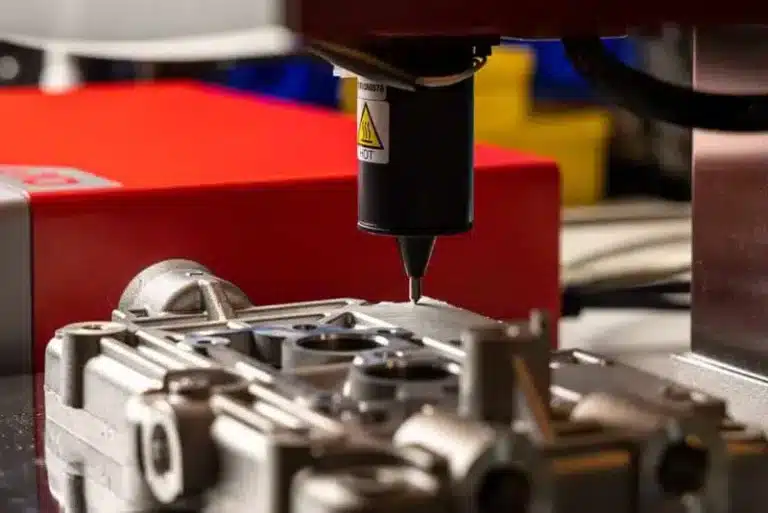
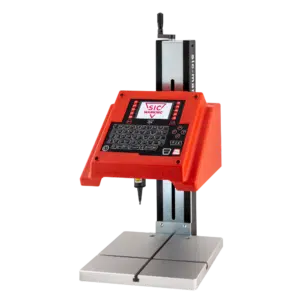
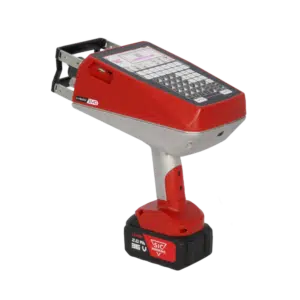
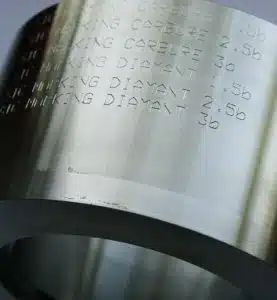
  • Dot peen marking machine for steel: portable dot peen machines for large or heavy-duty components, fixed standalone stations for repetitive production runs, or integrated dot peen heads for high-volume throughput,
  • Scribing marking machine for steel: standalone scribing units for deep marking of solid or heavy components, integratable scribing heads for robotic work cells, or dedicated deep marking solutions for VIN / chassis identification.
machine de marquage sur acier

Selection Criteria for Steel Marking Technology

Identifying the right marking technology for steel industrial parts requires evaluating several parameters: hardness, surface finish, alloy composition, part thickness, thermal sensitivity and the required contrast level.
Steel’s uniform surface structure, strong laser beam absorption, high impact resistance for dot peen marking and wear resistance for scribing make it a highly suitable substrate for demanding permanent marking applications.
Steel supports optimal machine-readable quality for Datamatrix and QR codes, long-lasting durability in severe operating conditions, and full compatibility across surface finishes.

  • Laser marking on steel is compatible with all hardness levels and particularly well-suited to thin-section parts. It produces a high-contrast black-and-white mark and achieves enhanced legibility on rough or textured surfaces.
  • Dot peen marking on steel performs best on smooth or polished surfaces, creating consistent, permanent indentation marks.
  • Scribing on steel produces deep, well-defined marks on medium-hardness steel grades, making it a reliable solution for demanding identification requirements.

Steel Hardness

Surface Finish

Steel Composition

Part Thickness

Thermal Sensitivity

Expected Contrast

Pattern hero

Steel Marking Options

Steel is compatible with all types of permanent marking: alphanumeric characters, 2D codes (Datamatrix), QR codes, barcodes, logos and deep marks.
The appropriate steel marking technology is determined by the application and any post-marking operations planned, including painting, galvanising or additional machining steps.
Laser marking on steel provides high-resolution output with strong contrast, dot peen marking on steel ensures excellent mark permanence and mechanical strength, and scribing achieves a deep, lasting mark profile for the most demanding traceability requirements.
fabricant station de marquage alphanumérique
Steel

Alphanumeric Marking

Alphanumeric marking is central to industrial traceability: serial numbers, lot numbers, part identifiers, internal references and variable data such as date, time or production counters. Serial numbers typically span 6 to 12 characters, with internal references commonly between 4 and 10.
Character heights of 2 to 5 mm are standard for comfortable human readability, with smaller sizes (0.3 to 1 mm) used for automated machine vision systems.

  • Laser marking on steel provides high precision (resolution typically down to ~0.05 mm) and strong contrast on stainless steel and heat-treated steel, making it the preferred process for fine characters and 2D codes.
  • Dot peen marking on steel produces a permanent indented mark, commonly used for parts that will be painted or exposed to abrasion, while scribing on steel achieves depths beyond 0.2 mm for outstanding long-term mark durability.

In production environments, laser marking is the standard solution for Datamatrix codes; it remains the reference technology for marking steel after painting and for meeting DPM compliance requirements.

  • Scribing on steel is the preferred approach for VIN, structural beams and forged components.

When selecting a steel marking technology, key factors include surface condition (bright, brushed or painted), required mark depth, and integration with machine vision systems and ERP platforms.
station de marquage Datamatrix
Steel

Datamatrix 2D Code

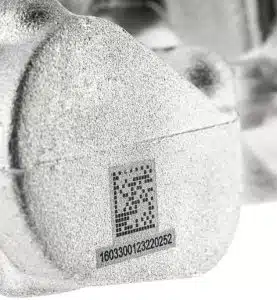
Datamatrix ECC200 codes, broadly adopted across automotive, aerospace and pharmaceutical industries, allow a high volume of data to be encoded within a compact symbol (2 to 10 mm).
When correctly configured, they remain scannable after painting or galvanising, with cell modules generally ≥0.25 mm to support reliable automated reading.
On steel, performance levels are consistently high: thousands of parts can be marked with read rates exceeding 99%. In manufacturing environments, these codes connect directly to process control systems and tracking tools such as MES platforms, supporting traceability, logistics coordination and maintenance planning.

  • Fibre laser marking is the standard solution for Datamatrix marking on steel, delivering high contrast, efficient cycle times and reliable repeatability.
  • Dot peen marking is a dependable alternative for demanding production environments, though it requires larger cell modules and yields lower contrast than laser.
  • Scribing on steel is rarely suited to high-density code marking. To ensure consistent read performance, it is recommended to validate each configuration using multiple readers and variable lighting conditions, and to confirm compliance with applicable contrast standards.
STEEL

QR Code

Less common than Datamatrix in industrial applications, QR codes are a practical choice when smartphone or tablet readability is part of the workflow. Their high data capacity (over 4,000 characters) allows URLs and detailed part records to be encoded directly within the symbol.
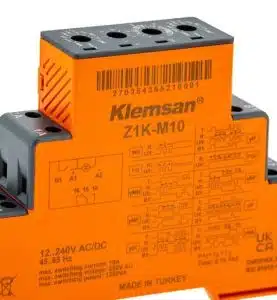
  • Fibre laser marking is the preferred solution for QR codes on steel: it delivers fine resolution, high contrast and accommodates compact cell modules (typically ≥ 0.4–0.5 mm). 20–50 W fibre sources are standard, with MOPA lasers specified when precise pulse control is required, particularly on stainless steel.
station de marquage de code barre & QR code
Steel

1D Barcode

1D barcodes remain a common solution for linear part identification on steel components, particularly in logistics and spare parts applications.
The most widely used formats — Code 128, Code 39 and EAN — encode between ten and twenty characters. Laser marking on steel with bar widths of 0.15 to 0.25 mm reliably supports automated scanner reading.
They integrate well into assembly lines with fixed short-range scanners. Laser marking enables fast output (up to 1–2 codes per second), while dot peen marking, though slower, provides greater mark durability in abrasive or challenging production environments.
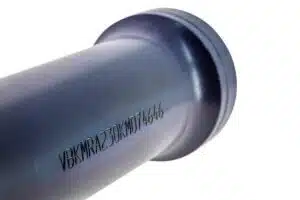
  • Laser marking is the recommended solution for barcodes on steel where bar edge definition is important: it delivers high contrast, precise line edges and dependable repeatability across production runs.
machine laser de marquage profond de l'acier
Steel

Deep Marking on Steel

For applications where mark durability is a primary requirement, deep marking is the proven solution: marks remain readable after machining, painting, sandblasting or galvanising.
In the automotive sector, deep marking is most commonly applied to VIN marking on chassis, where mark depth and continuity are critical for regulatory compliance and fraud prevention.
In steel construction and offshore environments, structural beams and flanges are deep-marked to maintain legibility after sandblasting and painting, while withstanding thermal cycling and exposure to corrosive conditions.
The rail industry and machine tool sector also depend on deep marking for forged components and safety-critical parts, with minimum mark depth requirements set out in customer and normative specifications. These robust permanent marks support long-term traceability and help avoid costly part replacement.

  • Scribing on steel is the most effective method for achieving significant mark depth, typically between 0.2 and 0.5 mm depending on steel hardness.
  • Dot peen marking on steel offers a strong balance between durability and production throughput, with achievable depths from 0.05 to 0.6 mm at industrial production rates.
  • Laser marking on steel can achieve deep marks through multipass processing, but is generally limited to approximately 0.01–0.2 mm, which extends cycle time. It is most relevant where fine character definition is required, but beyond 0.3 mm, scribing or high-force dot peen marking are more appropriate solutions.

In practice, permanent steel marking technology selection is guided by process constraints: scribing is preferred for forged parts destined for sandblasting, while dot peen marking is well-suited to components that will subsequently be painted.
machine de marquage pour logo
Steel

Logo and Pictogram

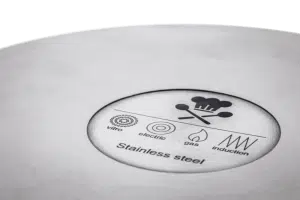
  • Laser marking on steel is the recommended solution for logos and fine-detail applications: a 20–50 W fibre laser achieves line widths of 20–50 µm and produces legible logos from as small as 1.5 mm, making it well-suited to identification plates and cast components.
  • Where resistance to downstream treatments is a priority (sandblasting, galvanising), a logo deep-marked by scribing offers greater long-term durability than a laser mark.

End-use requirements also guide the selection: pictograms that must remain visible after painting are frequently applied using dot peen marking, while compliance symbols require the precision and contrast that laser marking reliably provides.

Pattern hero

Applications by Industry Sector

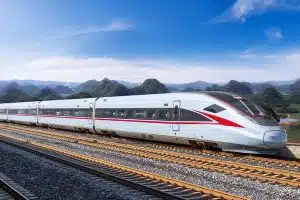
Steel, valued for its robustness, hardness and dimensional stability, is well-suited to permanent marking by laser marking, dot peen marking or scribing. These steel marking technologies maintain lasting legibility in severe operating environments while meeting compliance standards across the automotive, aerospace, rail, energy, medical and defence sectors.
Depending on the application, marking can be configured for deep penetration, high contrast or fine detail to address specific industrial and regulatory constraints.

machine de marquage pièce automobile

Automotive & Mobility

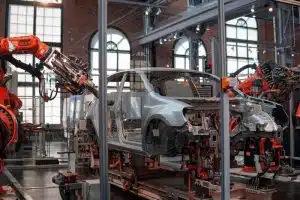
  • Engine number marking (engine block, cylinder head, crankcase): laser marking or dot peen marking of serial numbers, alphanumeric identifiers and Datamatrix codes.
  • Shock absorber reference marking (tubes, rods, steel bodies): laser marking of part references, barcodes and Datamatrix codes.
  • Identification of connecting rods, shafts and gears: dot peen marking of forged steel parts — lot numbers, Datamatrix codes and manufacturer internal codes.
  • Chassis & engine subframe: deep scribing of the structural identification number for lasting legibility and full resistance to paint and surface treatment processes.
Machine de marquage pour pièce aéronautique

Aerospace

  • Critical steel part marking (landing gear): dot peen marking with an adapted stylus of serial numbers and Datamatrix codes with controlled mechanical impact, delivering a stable, permanent mark on high-strength steel.
  • Structural fastener marking (fittings, hinges…): dot peen marking of Datamatrix codes on machined steel parts, and dot peen marking of structural references on forged steel components.
  • Tooling identification (maintenance tools, jigs and templates): dot peen marking of certification logos and QR codes, producing a clean, legible, non-distorting permanent mark.
  • Forged component marking (brackets, pins, articulations): dot peen marking of lot references and traceability codes, ensuring reliable mark integrity in demanding service environments.
machine de marquage pièce ferroviaire

Rail

  • Bogie component marking (frames, cross members, bolsters, axle boxes): scribing of serial numbers and maintenance codes for a deep permanent mark with lifetime legibility.
  • Axle, pin and rail shaft marking: laser marking of Datamatrix codes on machined steel surfaces, and dot peen marking of part identification numbers.
  • Coupler and interconnection marking: scribing of lot numbers and assembly references, providing resistance to anti-corrosion treatments and a continuous deep permanent mark.
  • Painted steel part marking (side members, chassis elements): scribing of structural serial numbers and Datamatrix codes.
machine de marquag pour secteur énergie

Energy, Oil & Gas

  • Steel flange marking (ANSI, API, DIN): deep scribing of lot numbers and Datamatrix codes on rough surfaces, providing resistance to saline and corrosive environments.
  • Valve and industrial fitting marking: dot peen marking on raw or unfinished surfaces of manufacturer references and serial numbers, maintaining legibility despite contamination, deposits and abrasion.
  • High-pressure steel connector marking: scribing of serial numbers for a mark that remains legible after sandblasting.
  • Steel pipeline marking: portable dot peen marking applied directly to large-diameter steel pipe.

Contact Us
Need more information?
Get in touch with one of our experts!
+1 450 449 9133
Contact us info@sicmarking.com