
Stainless steel laser marking applies durable information directly onto the material, such as serial numbers, part references, batch numbers, Data Matrix codes, QR codes, logos or regulatory information.
Depending on the requirements of the application, the laser can produce a simple surface contrast, an annealing mark on stainless steel or a deeper stainless steel laser engraving delivering enhanced resistance to mechanical and environmental stresses.
Thanks to the precision of the fibre laser, the information remains legible throughout the product life cycle, even in environments subject to wear, frequent cleaning or industrial stresses.
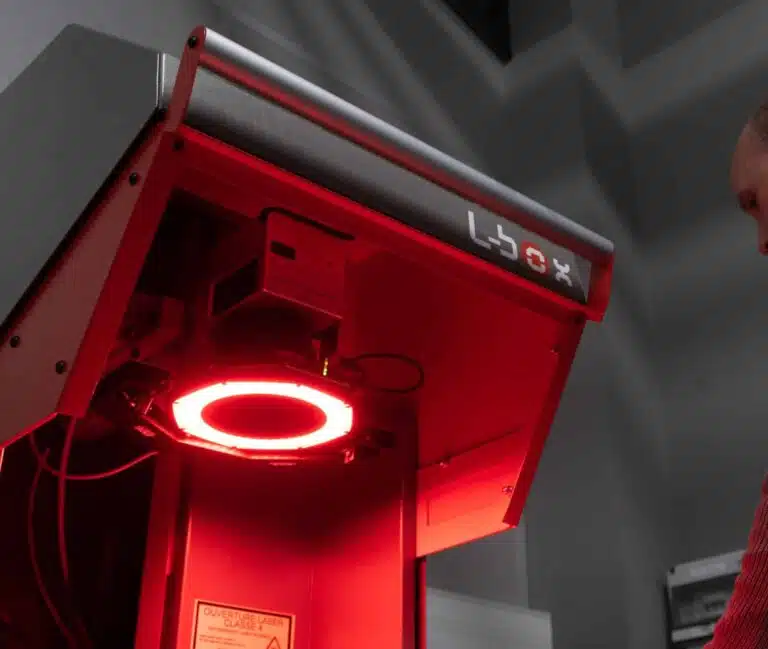
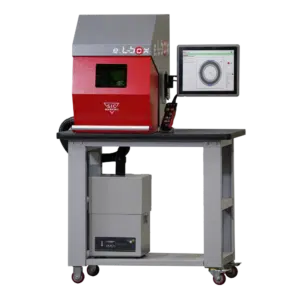
To meet the challenges of laser marking of stainless steel parts, SIC MARKING develops a complete range of industrial laser marking solutions dedicated to the permanent identification and traceability of stainless steel parts, whether standalone workstations, systems integrated into the production line or automated cells.
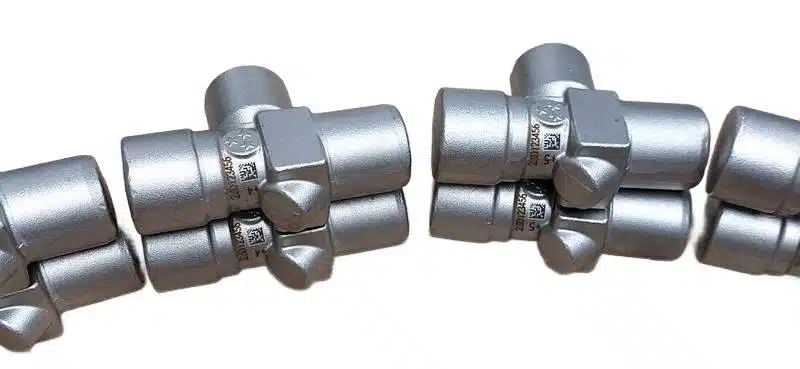
The identification of stainless steel parts is now a critical requirement across many industrial sectors.
Whether to guarantee component traceability, meet quality requirements or ensure the durable retention of information throughout the product life cycle, stainless steel laser marking stands out as a technology particularly suited to demanding industrial applications.
Thanks to its precision, repeatability and ability to produce permanent marks on stainless steel, the laser embeds the information required for identification, production tracking and quality control directly into the material.
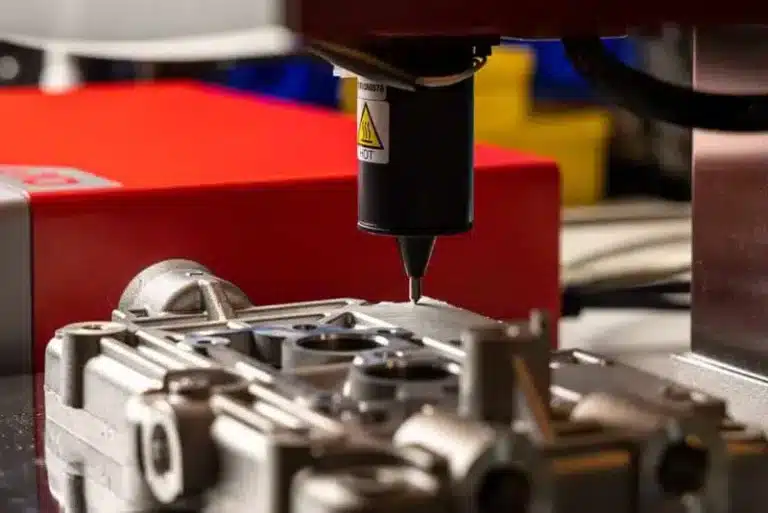
Stainless steel laser marking relies on the interaction between the high-energy laser beam and the surface of the stainless steel. When the beam is focused onto the material, the light energy is absorbed and converted into thermal energy, producing different surface modifications according to the marking parameters applied.
Laser power, pulse frequency, scanning speed, spot size and the number of passes directly influence the result achieved. Depending on the objectives, the laser can create a simple visual contrast, locally alter the surface structure of the stainless steel or carry out genuine laser engraving on stainless steel with material removal.
This adaptability meets both the needs of cosmetic identification and the most demanding requirements for industrial traceability, Data Matrix marking or permanent engraving on stainless steel.
Stainless steel laser marking is compatible with every grade of stainless steel used in industry.
However, the way the material responds to the laser beam can vary according to its metallurgical composition, surface finish, heat treatment or the finishing operations carried out after manufacturing.
The precision of stainless steel laser marking makes it possible to embed a wide variety of information directly onto parts for identification, industrial traceability, quality control or production tracking. Thanks to the fineness of the laser beam, alphanumeric characters can be produced just as readily as barcodes, Data Matrix codes, QR codes, industrial logos or regulatory information with an excellent level of detail.
Depending on the needs of the application, laser engraving on stainless steel can be used to provide unit-level identification of a part, streamline quality control operations, meet regulatory requirements or secure production and maintenance flows.
The terms stainless steel laser marking, stainless steel laser annealing and stainless steel laser engraving are often used to describe a single technology. In practice, however, these processes correspond to different modes of interaction between the laser beam and the stainless steel.
Depending on the parameters used, the laser may simply alter the visual appearance of the surface, induce a controlled metallurgical change in the surface layer, or remove a greater or lesser amount of material.
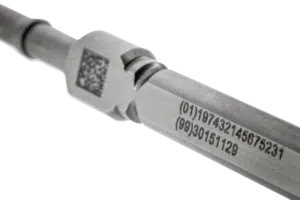
Contrast laser marking consists in creating a visual difference on the stainless steel surface without necessarily producing a deep engraving into the material.
The action of the laser beam locally alters the reflectivity, texture or surface appearance of the material to reveal the required information. This change generally remains very shallow while still delivering excellent visual quality.
Thanks to its high precision, contrast stainless steel laser marking is particularly suited to producing text, part references, logos, serial numbers, Data Matrix codes or QR codes that require excellent graphic definition.

Annealing marking on stainless steel, also known as annealing marking, is one of the most specialised laser applications on stainless steel.
Unlike conventional engraving, the laser is not intended to remove material but to generate precisely controlled localised heating. This temperature rise modifies the surface layer of the material and forms a thin oxidation layer that creates a distinctly visible dark contrast.
The main advantage of stainless steel laser annealing is that the surface remains virtually intact. The mark is visible without creating any significant recess or substantially altering the part’s surface finish.
Annealing marking is also valued for the contrast quality achieved on austenitic stainless steels such as grades 304, 304L, 316 or 316L, which are widely used in these industries.
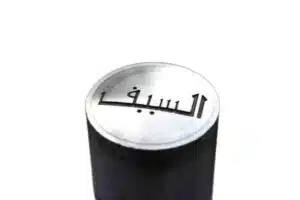
Stainless steel laser engraving works on a different principle.
In this case, the energy delivered by the laser beam causes localised melting and then vaporisation of part of the material. This controlled ablation creates a recessed mark directly in the stainless steel.
The depth achieved depends on several parameters, including laser power, scanning speed, the number of passes performed and the grade of stainless steel involved.
Laser engraving on stainless steel generally offers the highest level of resistance to industrial stresses. The information stays legible despite friction, abrasion, intensive cleaning, chemical splashes or particularly aggressive environments.
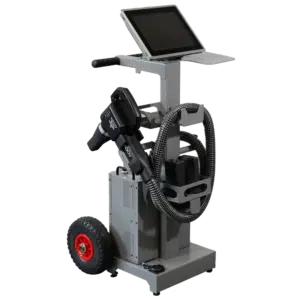
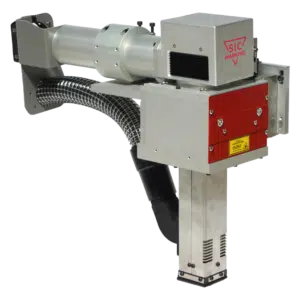
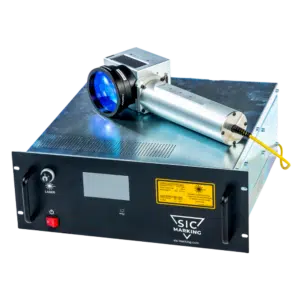
Explore our flagship laser marking equipment, from our portable machines and line-integrable modules to standalone marking stations.
Contact us
Need information?
Get in touch with one of our experts!


Stainless Laser
Which stainless steel laser marking process should you choose for your application?
The choice between contrast laser marking, stainless steel laser annealing and stainless steel laser engraving depends primarily on the part’s operating environment and the level of durability required.
Thanks to their flexibility, SIC MARKING laser marking solutions can produce both high-contrast marks and permanent engravings that meet the most stringent traceability requirements in industry.