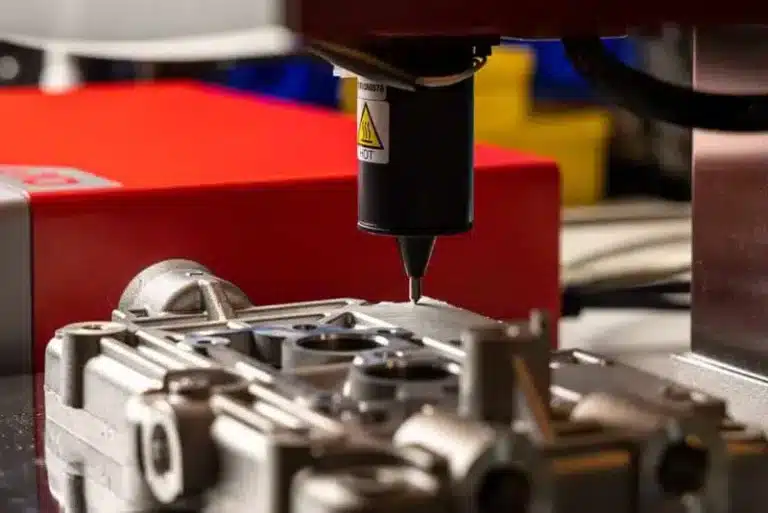
A part marked at the start of the line. Then painted. Then heat-treated. Then assembled. At every stage, one more chance to lose the identifier that made it traceable. This is a scenario automotive and mechanical workshops face regularly: the marking is there at the start, gone by the end. Technically speaking, what actually separates a mark that holds from one that fades away?
The answer comes down to one word: depth.
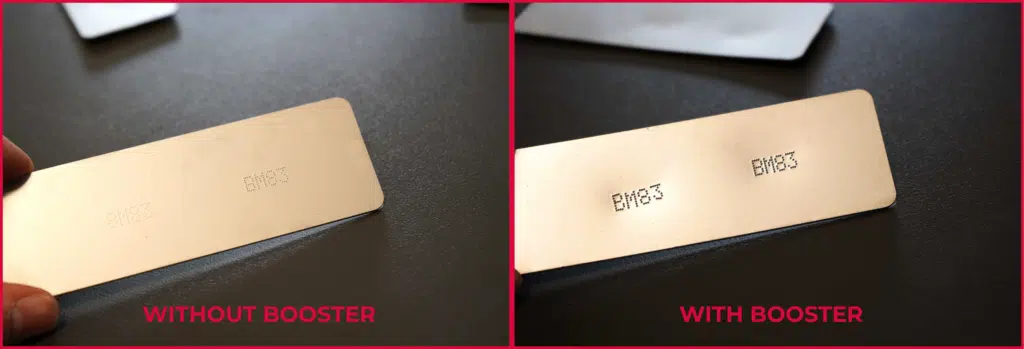
As soon as it goes through painting, surface treatment or heat treatment, the engraving fades or disappears completely. The consequence goes well beyond appearance: without a legible identifier, the part drops out of the traceability system, which can trigger a non-conformity at the end of the line, exactly when it’s most costly to catch.
This is what we set out to solve, with two complementary answers depending on the production context.
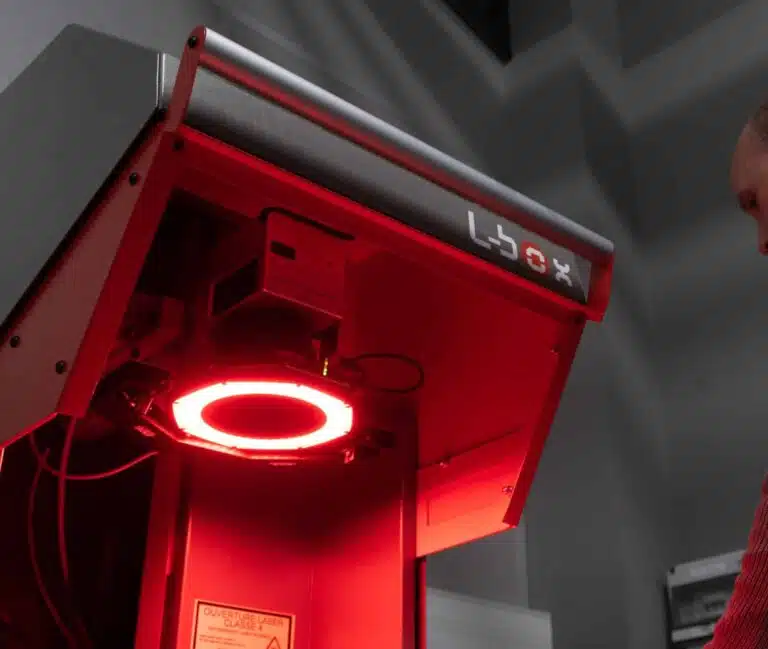
For one-off needs or small batches, we developed the e-MARK EVO in its Booster version. It engraves quickly, with precision, and above all in depth, deep enough for the mark to stay identifiable even after painting or surface treatment.
For series production, our Deep Marking range offers line machines calibrated for the same durability requirement, with a marking depth greater than 0.2 mm. This depth lets the mark withstand three types of stress that an automotive or mechanical part goes through over its lifecycle:
In both cases, Booster and Deep Marking alike, the logic is the same: build traceability into the marking stage itself, rather than discovering the problem at the end of the chain. A part marked to a depth of 0.2 mm no longer raises the question of legibility after painting: it’s designed to withstand it.
In practice, this changes the nature of quality control. Instead of checking after the fact whether the mark survived the process, the workshop can treat legibility as a given from the marking stage onward, and focus its checks on other critical points along the line.
We support you from analysing your process, treatments applied, mechanical stresses, production volumes, through to commissioning your e-MARK EVO Booster or Deep Marking solution.
A mark that withstands everything your process puts it through: that’s direct part marking.
Article written with the expertise of Fabien Nicot, Technical Director
Need information?
Get in touch with one of our experts!