The choice of copper marking technology — laser, dot-peen, or scribing — is based on three measurable criteria: marking precision (resolution), achieved depth, and mechanical and chemical durability of the mark.
As a highly thermally and electrically conductive material, copper has strong reflectivity to laser radiation and rapid heat diffusion. These properties directly influence laser marking, which requires precise parameter adjustments (power, pulse duration, frequency) to limit line widening and preserve readability without excessive surface alteration.
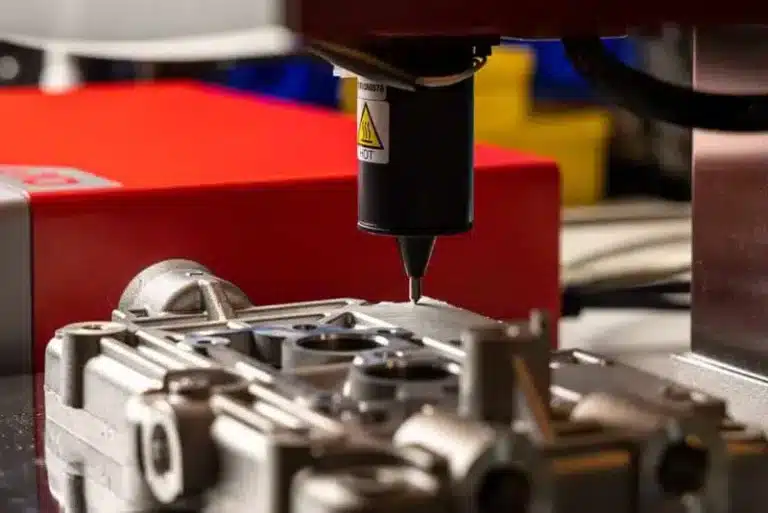
Copper alloys (brass, bronze, cupronickel, CuBe) have higher hardness and reduced ductility compared to pure copper. These characteristics make mechanical dot-peen marking particularly suitable for achieving a durable engraved mark, provided the part has sufficient thickness and rigidity.
Thanks to its versatile properties and exceptional recyclability, copper is a key material for the energy, electronics, maritime, and medical sectors.
SIC MARKING offers copper marking solutions suitable for permanent part identification, combining laser marking, dot-peen, and scribing, while taking into account the specific thermal, mechanical, and chemical properties of copper and its alloys.
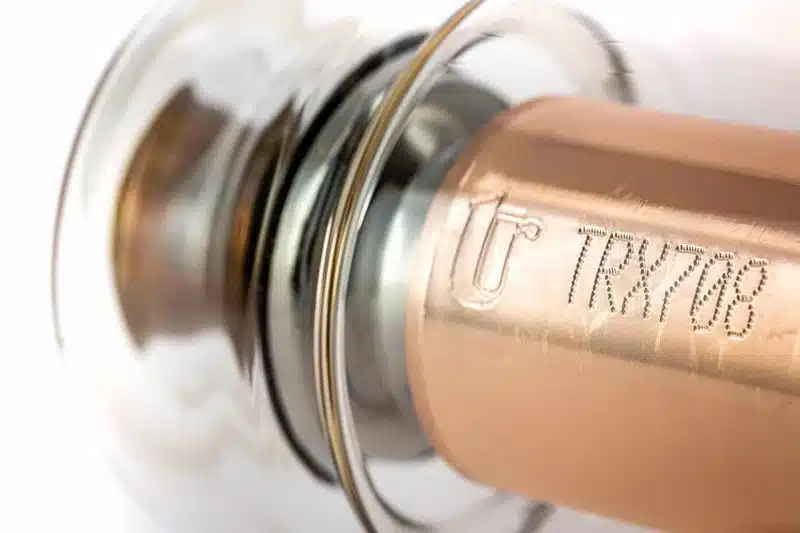
Whether used as pure copper or in alloys such as brass or bronze, this material, due to its ductility, laser reflectivity, and high thermal conductivity, requires careful selection of marking technology.
Copper offers a set of properties — thermal and electrical conductivity, ductility, homogeneous surface, and tendency to oxidize — making it an excellent choice for permanent marking in industrial environments. However, its tendency to oxidize can affect mark readability, especially in humid conditions.
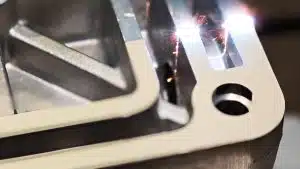
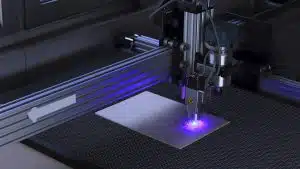
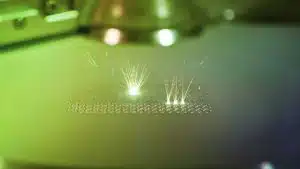
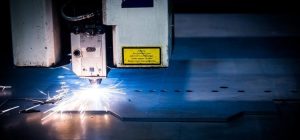
Laser engraving on copper is recommended for fine markings and 2D codes, with laser parameters carefully adjusted to compensate for copper’s high reflectivity and ensure precise marking without damaging the surface.
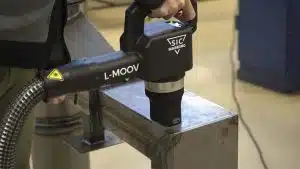
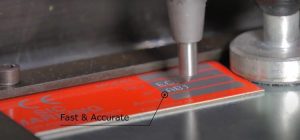
Dot-peen marking is preferred for applications subject to high mechanical stress and is better suited for copper alloys to ensure marking durability.
Scribing on copper and copper alloys is recommended for structural copper components and aesthetic marking, requiring deep, legible marks on thick parts.
The choice of permanent copper marking technology depends on the desired level of precision, expected contrast, required robustness, and thermal management necessary to preserve thin parts and prevent surface alteration, particularly during laser marking.
Copper Thermal Conductivity
Geometry and Thickness of the Copper Part
Electrical Conductivity
Corrosion Resistance
Tendency to Oxidation
Copper accommodates a wide variety of permanent markings—laser engraving, micro-percussion marking, and scratching marking—and the choice of marking technology depends on the desired level of detail, engraving depth, or durability.
The types of markings achievable on copper and copper alloys range from micro-marking (10–50 µm) to deep marking (50–200 µm), with each marking technique addressing specific requirements:
The choice of copper marking technology results from a compromise between the desired graphic fineness, required mechanical depth, long-term contrast stability, and thermal management dictated by the material.
Each process—laser, micro-percussion, or scratching—thus meets distinct industrial requirements depending on the usage environment and the functional constraints of the part.
Sectors such as microelectronics, medical, automotive, aerospace, energy, railway, and luxury dictate the choice of code (DMC, QR, barcodes, serial numbers, reference marks, pictograms) according to readability, traceability, and durability requirements.
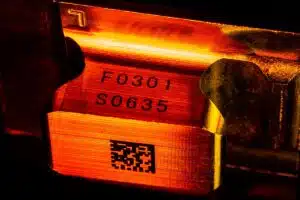
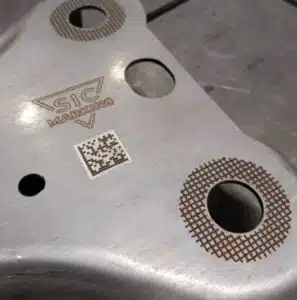
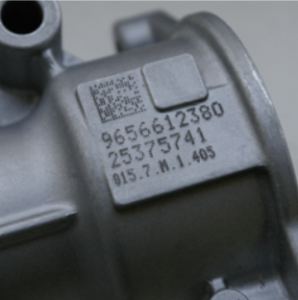
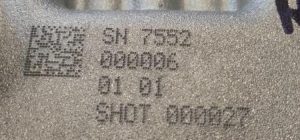
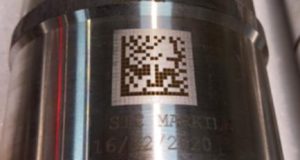
When implementing a Datamatrix ECC200 on copper or copper alloys, manufacturers target a module size compatible with the reader.
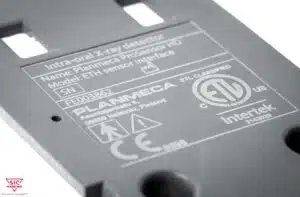
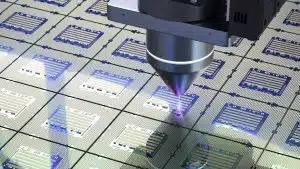
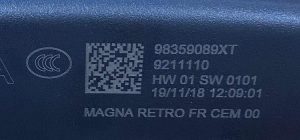
Laser marking enables fine markings and high-density micro-codes, suitable for applications requiring high resolution and optimal contrast.
Micro-percussion marking produces deep dots (from 0.1 to 0.3 mm), offering excellent mechanical and chemical resistance, making it particularly suitable for demanding industrial environments.
In contrast, scribing is generally avoided for DataMatrix codes due to its lack of fineness and limited ability to generate high-density readable codes, especially on small, detailed surfaces required for micro-codes.
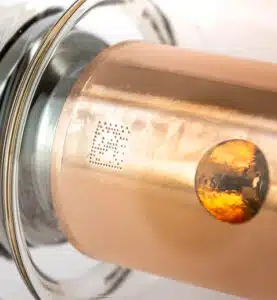
In many industrial environments, the QR Code is chosen for its ability to store URLs and metadata, as well as for its fast readability, particularly on production lines.
In production, laser engraving on copper provides clean and precise marking, ideal for applications requiring high-density codes and fine resolution, especially for QR Codes and DataMatrix codes.
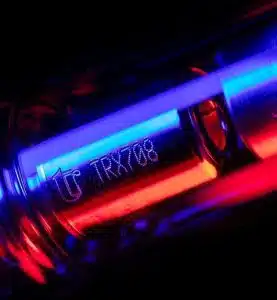
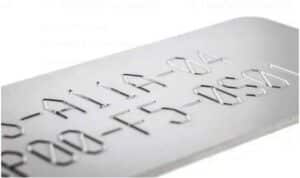
For serial number identification, fiber laser engraving of copper or copper alloys is preferred for its precision and speed: it allows typical character heights from 0.5 to 2.0 mm with resolutions sufficient for OCR and camera reading.
Depending on the copper alloy and surface condition, laser marking of serial numbers relies on localized thermal interaction, either by controlled ablation or surface oxidation. This marking method provides readable contrast without mechanical deformation of the part, given precise laser parameter settings.
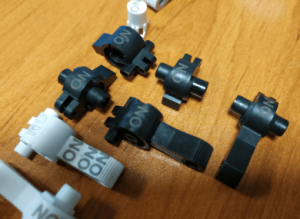
Micro-percussion marking is recommended when mechanical durability is critical: it achieves controlled depths of 50 to 150 µm, able to withstand vibrations and aggressive cleaning.
Scribing marking is favored for massive copper parts when seeking depths of 100 to 200 µm and immediate readability, especially in contexts where oxidation or surface treatments may reduce the visibility of shallow marks.

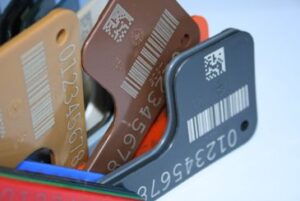
Laser marking remains the preferred solution in production for a clean and continuously readable 1D barcode, particularly for common symbologies such as Code 128 or Code 39, due to its speed, precision, and adaptability to materials like copper and its alloys.
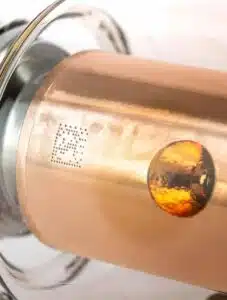
Thanks to fiber laser technology, it is possible to achieve extremely fine text on copper: micro-markings from 10 to 50 µm for medical UDIs or pad indicators, and characters readable by camera from approximately 0.2 mm in height.
Laser marking produces contrast through oxidation or controlled ablation, while micro-percussion can reach depths of 50 to 150 µm for superior mechanical durability, ideal for applications requiring high wear and stress resistance.
For functional indicators, typical heights are 1.5 to 4 mm with micro-percussion, and engraving 50 to 200 µm deep by scribing on massive copper parts exposed to abrasion.
In production, laser marking is preferred for fine lines and fast execution, while industries turn to micro-percussion or scribing when resistance in harsh environments and mechanical durability of the marking become priorities.
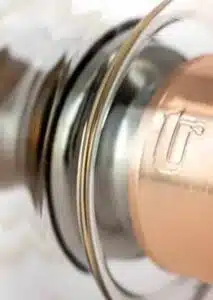
The high-resolution fiber laser marking allows for extremely fine logos, with micro-markings from 10 to 50 µm and line widths generally between 20 and 50 µm.
This type of copper marking provides an aesthetic finish particularly suited for the luxury and precision electronics sectors, and is the preferred solution whenever a pictogram requires regularity and contrast without altering the geometry of the copper part.
In harsh environments, micro-percussion (dot-peen) delivers a highly legible technical finish: points of 0.2 to 0.5 mm, pitch of 0.25 to 0.5 mm, and depths of 50 to 150 µm, ensuring optimal mechanical durability and readability even with oxidation.
Scribing marking is used for robust decorative applications or technical markings where a depth greater than 50 µm (up to 200 µm) is required, although its rougher finish makes it less suitable for fine lines.
Permanent copper marking meets regulatory and quality requirements by ensuring unique identification (serial number, Datamatrix, QR Code), compliance with automotive, aeronautics, medical, and energy standards, as well as production tracking and digital archiving.
It guarantees reliable automatic reading, online or offline, and protects the traceability of critical copper parts during manufacturing.
The full range of material characteristics guides the choice of alloys – brass, bronze, cupronickel, CuBe – and explains the predominant uses of copper and copper alloys in the electrical and electronics sectors, automotive, aeronautics, energy, the marine sector, valves & fittings (often bronze parts where serial numbers are marked with pictograms indicating fluid direction), as well as the medical sector.





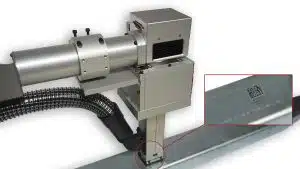
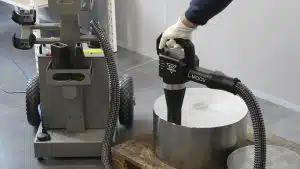
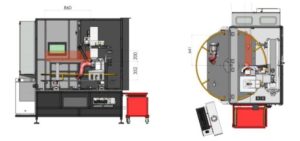
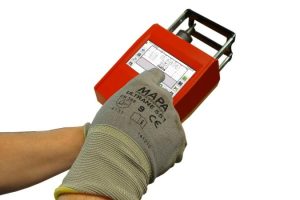
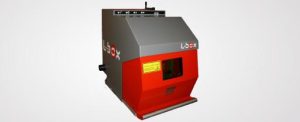
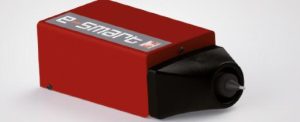
Explore our flagship laser marking, micro‑percussion, or engraving equipment, including Portable Machines, Integrable Modules for Production Lines, or Standalone Marking Stations.
Contact Us
Need more information?
Get in touch with one of our experts!